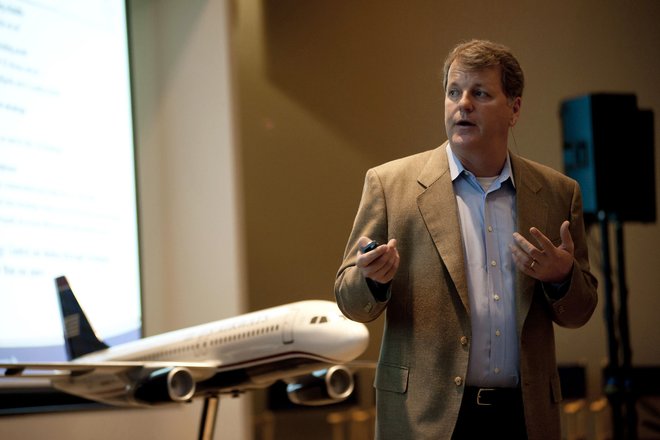
Scott Kirby, CEO of United Airlines, has publicly confirmed what industry insiders have speculated about for months: he personally initiated discussions with American Airlines about a potential merger. In a candid interview, Kirby admitted, “I reached out, and they weren’t interested.” The revelation opens a rare window into high-stakes corporate maneuvering in the airline industry—where scale, network reach, and long-term survival increasingly depend on strategic positioning.
This wasn’t a speculative rumor. It was a deliberate, top-level outreach. And while American Airlines swiftly declined, the mere fact that the conversation occurred underscores a pivotal shift in how major carriers are thinking about competition, profitability, and the future of air travel.
Why United Wanted a Merger
United’s interest in merging with American isn’t about desperation—it’s about dominance. The U.S. airline industry has long operated under an oligopoly, with four major players: United, American, Delta, and Southwest. But dominance isn’t just about market share. It’s about control over routes, pricing power, labor leverage, and long-term resilience.
A union between United and American would have created the world’s largest airline by available seat miles (ASMs). The combined network would span over 1,000 destinations globally, with unmatched domestic coverage, especially in key hubs like Dallas (DFW), Chicago (ORD), and Houston (IAH).
More importantly, such a merger would have addressed one of United’s core strategic weaknesses: regional connectivity. While United excels in international long-haul routes, it lags behind American in short-haul domestic coverage, particularly in the South and Midwest. American’s strength in regional feeder traffic would have plugged that gap.
Kirby’s move was not impulsive. It was a calculated play to future-proof United against:
- Rising fuel and labor costs
- Intensifying competition from ultra-low-cost carriers (e.g., Spirit, Frontier)
- Shrinking returns on transatlantic and transpacific routes
- Regulatory uncertainty around sustainability mandates
A merger would have allowed for fleet standardization, cost synergies, and a stronger balance sheet to invest in next-gen aircraft like the Boeing 787 and Airbus A350.
American’s Refusal: Pride, Politics, or Prudence?
American Airlines’ rejection wasn’t surprising—but it was telling. The carrier has spent the past decade rebuilding its brand after the 2013 merger with US Airways. CEO Robert Isom has consistently emphasized stability, operational reliability, and financial recovery. A new mega-merger would have disrupted that trajectory.
But beyond optics, there are real structural barriers:

- Antitrust scrutiny: A United-American merger would face near-certain resistance from the Department of Justice (DOJ). The combined airline would control over 50% of key domestic markets like D.C.-New York and Chicago-Denver. DOJ blocked the merger of JetBlue and Spirit in 2024 over similar concerns—this would be ten times more complex.
- Cultural misalignment: United and American have vastly different operational cultures. United has aggressively invested in premium cabins and international expansion. American has focused on domestic loyalty and cost discipline. Merging these philosophies would be messy.
- Labor complications: Both airlines have powerful unions. Harmonizing contracts, seniority lists, and work rules would take years—and likely trigger strikes.
Insiders suggest American leadership also doubted United’s ability to lead such an integration. Delta’s successful absorption of Northwest Airlines is still the gold standard. United’s 2010 merger with Continental, by contrast, was plagued by integration failures, IT breakdowns, and customer backlash.
In short: American didn’t say no because the idea lacked merit. They said no because the risks outweighed the rewards—especially with United at the helm.
What This Means for the Airline Industry
Kirby’s admission isn’t just a corporate gossip item. It signals a broader industry inflection point.
Airlines operate on razor-thin margins. The post-pandemic recovery has been uneven. While demand is strong, profitability is under pressure. Labor shortages, air traffic control delays, and rising maintenance costs are eating into earnings.
Mergers are a classic response to consolidation pressure. The last wave—from Delta-Northwest to United-Continental to American-US Airways—reshaped the industry in the 2010s. Now, the cycle may be repeating.
But the environment is different. In the 2010s, mergers were often approved because they stabilized failing carriers. Today, the majors are profitable. Regulators are less forgiving. Consumers are more vocal.
Still, the incentive remains: scale wins. Consider these realities:
- Transatlantic capacity wars: United, American, and Delta are battling for dominance on North Atlantic routes. A merged United-American could dominate premium traffic to London, Frankfurt, and Tel Aviv.
- Asia-Pacific ambitions: China and India represent the next frontier. United has strength in Japan and Australia. American has limited presence. A combined network could challenge Delta’s dominance.
- Loyalty monetization: Airline loyalty programs are now worth billions. United’s MileagePlus and American’s AAdvantage are both highly lucrative. A merger could create the most valuable travel rewards ecosystem in the world.
Even if a full merger is off the table, partial collaborations—like joint ventures or codeshare expansions—may follow.
The Delta Factor: Why This Benefits Delta
While United and American debated, Delta quietly strengthened its position.
Delta Air Lines has avoided the merger conversation—by design. Under CEO Ed Bastian, Delta has focused on operational excellence, customer experience, and financial discipline. The strategy is working: Delta consistently ranks highest in customer satisfaction and on-time performance.
A failed United-American merger only widens Delta’s lead.
Consider the competitive landscape:
| Carrier | Domestic Market Share | International ASMs | Customer Satisfaction Rank |
|---|---|---|---|
| Delta | 16.2% | 28% | #1 (J.D. Power 2024) |
| American | 15.8% | 22% | #3 |
| United | 14.7% | 25% | #2 |
Delta’s strength in key business markets—New York, Atlanta, Seattle, Los Angeles—gives it pricing power. Its transatlantic joint venture with Air France-KLM and Virgin Atlantic is deeply entrenched. And its lack of merger baggage means cleaner operations and stronger labor relations.
If United and American are preoccupied with what-ifs, Delta is executing.
Kirby’s outreach may have been a bold power play. But it also revealed a vulnerability: United may need a partner to keep pace. Delta doesn’t.
Could the Merger Still Happen?
Never say never.
While American rejected the idea today, circumstances change. A downturn in the economy, a spike in fuel prices, or a leadership shift at American could reopen the door.
But any future attempt would need to overcome major hurdles:
- Regulatory strategy: United would need to offer significant divestitures—likely entire hubs—to gain DOJ approval. Think: spinning off United’s Denver operations or American’s Philadelphia hub to a low-cost carrier.
- Labor roadmap: A detailed integration plan for pilots, flight attendants, and mechanics would be essential. No more “we’ll figure it out later.”
- Customer experience plan: Post-merger service meltdowns destroy brand value. United-Continental is still a cautionary tale.
And politically, antitrust sentiment is rising. The Biden administration has taken a hard line on corporate consolidation. A United-American merger would be a lightning rod.
Still, history shows that when airlines want to merge—and when the economic case is strong enough—they find a way.
What Travelers Should Watch For You don’t need to be a Wall Street analyst to see how this affects your next trip.
Even without a merger, the ripple effects are real:
- Fewer nonstop options: On overlapping routes (e.g., Chicago-Dallas), expect reduced frequency or aircraft downsizing.
- Higher fares: Less competition means higher prices, especially on business-heavy corridors.
- Loyalty program changes: Airlines may accelerate partnerships or co-branded credit card deals to boost revenue.
- More codeshares: Watch for expanded alliances, especially on international routes where United and American currently compete.
For frequent flyers, the message is clear: diversify your loyalty. Don’t put all your miles in one airline. Use co-branded cards strategically. And pay attention to which carrier actually operates your flight—not just the one selling the ticket.
The Bottom Line
Scott Kirby’s confirmation that he approached American Airlines about a merger isn’t just corporate drama. It’s a strategic signal. The airline industry is entering a new phase of consolidation, competition, and transformation.
United sees a future where scale is non-negotiable. American isn’t ready to bet its identity on that vision. And Delta? It’s watching, waiting, and winning.
For now, the status quo holds. But in an industry where the rules change overnight, today’s “no” could be tomorrow’s inevitability.
If you're investing, flying, or working in aviation—pay attention. The next move could redefine the sky.
Frequently Asked Questions
Did American Airlines ever consider merging with United? No. American Airlines leadership rejected the overture outright. There’s no evidence they conducted due diligence or held formal talks.
Would a United-American merger have been legal? Highly unlikely without massive divestitures. The Department of Justice would almost certainly block it on antitrust grounds due to market concentration.
How would a merger affect frequent flyers? It could lead to a super loyalty program with more redemption options—but also fewer flight choices and higher award prices due to reduced competition.
Is United likely to pursue another merger? Possibly, but not soon. Alaska Airlines or JetBlue could be more viable targets, though regulatory and cultural challenges remain.
What did Scott Kirby gain by going public with this? It positions United as aggressive and forward-thinking. It also applies soft pressure on American and signals to investors that Kirby is exploring bold growth options.
Could Delta be next to make a move? Delta has avoided mergers, but it’s not off the table. A strategic acquisition—like Hawaiian Airlines or a European carrier—could be more palatable than a domestic mega-merger.
How do mergers impact flight crews and employees? They create uncertainty. Seniority integration, base assignments, and pay scales often take years to resolve. Past mergers have led to strikes and labor disputes.
FAQ
What should you look for in United CEO Confirms Merger Talks with American Airlines? Focus on relevance, practical value, and how well the solution matches real user intent.
Is United CEO Confirms Merger Talks with American Airlines suitable for beginners? That depends on the workflow, but a clear step-by-step approach usually makes it easier to start.
How do you compare options around United CEO Confirms Merger Talks with American Airlines? Compare features, trust signals, limitations, pricing, and ease of implementation.
What mistakes should you avoid? Avoid generic choices, weak validation, and decisions based only on marketing claims.
What is the next best step? Shortlist the most relevant options, validate them quickly, and refine from real-world results.